
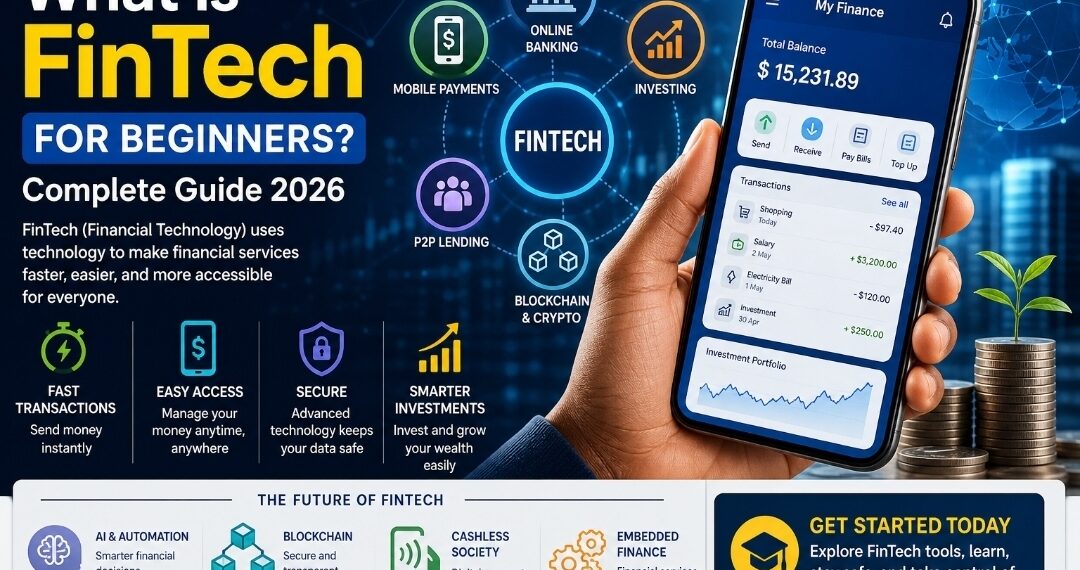
What is FinTech for beginners. Our relationship with money is changing rapidly in this fast-paced digital world. From sending money through mobile apps to investing in stocks online, technology is transforming the financial industry in ways never seen before.
This change is often called financial technology or FinTech. But many still ask what is FinTech for beginners and how it actually works in real life? FinTech, simply put, is the use of technology to make financial services better and more automatic.
This means that financial services become faster, easier to access and more convenient for all.You are already experiencing FinTech in your everyday life, whether it’s a mobile wallet, bill payments online, or the use of cryptocurrency.
You will learn what is FinTech, how it works, the benefits and risks and how you can start using it in a safe and effective way.
What is FinTech?
FinTech is short for financial technology, and refers to the use of technology to improve and automate financial services. In plain English, it’s the way people use apps, websites and digital tools to make managing money easier.
If you are still wondering what is FinTech for beginners, the easiest way to understand is:
FinTech is the combination of finance and technology to make financial activities faster, easier and more accessible.
How Technology is Changing Finance
Technology has completely changed the way we transact money today. For example you:
Send money with your mobile instantly
Use online banking services without the need to visit a branch
Apps to buy stocks or cryptocurrencies on the go
Sophisticated technologies like artificial intelligence (AI) and blockchain are also transforming financial services.
More secure
Faster
More efficient
This change has made financial services more convenient for both individuals and businesses.
Traditional Finance & FinTech
The difference between traditional finance and FinTech is clear:
Traditional Finance:
Uses physical banks and offices
Transactions may take hours or days
FinTech often has higher fees:
Works via apps and online platforms
Allows for instant transactions
Often provides lower costs and more accessibility
Endowed with these advantages,
FinTech Timeline
Early Stage (ATMs, Credit Cards)
We know FinTech already, but if you’re wondering What is FinTech for beginners, it helps to look at where it all started. It began decades ago with innovations such as:
Automated Teller Machines (ATM)
Credit cards
These initial inventions made it more convenient for individuals to spend and access their money without having to visit a bank.
Digital Revolution (The Era of Online Banking, PayPal)
With the advent of the internet, FinTech entered a new phase:
Banking online became widely available
PayPal made it easy to send money online and receive it
E-commerce platforms grew rapidly
Now people could look after their money from anywhere in the world.
Modern FinTech (AI, Blockchain, Apps)
Today, FinTech has come a long way. For anyone asking What is FinTech for beginners, modern innovations provide the clearest answer:
Artificial Intelligence (AI) is used for smarter financial decisions
Blockchain technology ensures secure and transparent transactions
Mobile apps allow users to manage money, invest, and pay instantly
What is FinTech for Beginners Guide Major Types of FinTech
To understand FinTech for beginners, it is important to break it down into its main categories. FinTech is not one tool, but a collection of technologies that are transforming the way people manage, send, invest and borrow money.
The following are the main types of FinTech you should know about:
a. Electronic Payments
Digital payments are one of the most common forms of FinTech today. People can send and receive money instantly through digital platforms instead of using cash.
b. Neobanks (Online Banking)
Another important concept in learning what is FinTech for beginners is online banking or neobanking. These banks have no physical branches, so everything is done through apps or websites.
They provide services such as savings accounts, transfers, budgeting tools, and even loans.
Examples and benefits
Cheaper fees compared to regular banks
Speedier account creation
Easy-to-use mobile apps
Around the clock access to financial services
Neobanks are built to simplify banking, especially for the tech-savvy.
c. Investing & WealthTech
FinTech has democratised investing, not just for the professionals.
Stock trading apps allow novices to trade shares with a mere smartphone.
Robo-advisors use algorithms to manage your investments automatically based on your goals and risk tolerance.
This category is important in understanding what is FinTech for beginners because it showcases how technology is breaking down barriers to building wealth.
This category is significant in understanding what is FinTech for beginners because it demonstrates how technology is reducing the barriers to building wealth.
d. Lending & Crowdfunding
FinTech has transformed the way people lend and raise funds.
Loans online are faster to approve than traditional banks.
Peer-to-peer (P2P) lending websites connect borrowers directly with lenders.
Crowd funding platforms these allow individuals or businesses to raise funds from a large pool of people online.
This contributes to financial inclusion, especially for those who might not qualify for conventional bank loans.
e. Crypto & Blockchain
Digital currencies and blockchain technology is one of the most advanced areas of the FinTech.
Bitcoin and other digital assets enable decentralised transactions without central banks.
Blockchain technology provides safety and transparency in financial transactions.
FinTech for Beginners – How FinTech Works
To understand what is FinTech for beginners, it helps to look at what FinTech actually does behind the scenes. FinTech uses a variety of new technologies to provide financial services that are fast, secure and easy to use.
Apps, APIs and Cloud Computing
Apps These are the things that users interact with such as mobile banking apps, payment apps and investment platforms.
APIs (Application Programming Interfaces) link systems, enabling banks, apps, and services to share information securely.
Cloud computing saves data online, so users can access financial services anytime, anywhere.
Together, all three of these components create seamless financial experiences.
Data analytics and AI use
Artificial intelligence (AI) and data analytics are the engines of the FinTech. AI helps to detect fraud, analyse spending habits and offer personalised suggestions.
Using data analytics, companies can make better decisions based on how users behave.
This makes FinTech platforms smarter and more efficient.
Automation in Finance Services
Automation does away with manual processes.
Manage your money more easily with automatic payments, savings plans and investment tools.
Automation lets companies reduce errors and get work done faster.
For those new to what is FinTech, one of the biggest advantages is automation.
Advantages of FinTech
FinTech has changed the financial industry by making services faster, cheaper and more accessible.
Swift Transactions make money transfers and payments instantly, even in different countries.
Reduced Costs FinTech also reduces operational costs by eliminating the need for physical branches and manual processes.
Financial Inclusion this is especially true for developing countries. “FinTech enables the unbanked to gain access to financial services through their mobile phones.
Convenience (Access 24/7) Manage your money anytime, anywhere – without visiting a bank.
Risks and Challenges of FinTech
FinTech has a lot of advantages, but it also has challenges that beginners should be aware of.
Security Risks (Cyber Attacks) Hackers can penetrate digital platforms, making cybersecurity a must.
Data Privacy Concerns FinTech companies are also gathering large amounts of personal data, which is raising questions about privacy and how the data is used and protected.
Regulation and Compliance Different laws in different countries make it hard for FinTech companies to operate globally.
Challenges of Digital Literacy not everyone has access to digital financial tools, especially people in rural or underserved communities.
Examples of FinTech in Real Life
Here are some real world examples to better understand what FinTech is for beginners:
M-Pesa and other mobile money services allow users to send and receive money using their phones.
PayPal and Stripe are payment platforms that allow individuals and businesses to make online transactions.
Crypto platforms offer users access to digital currencies such as Bitcoin. These examples illustrate how FinTech is already present in everyday life.
FinTech in Africa (A Compelling Growth Story) FinTech is booming in Africa and it is a big topic when talking about what is FinTech for beginners.
FinTech in Africa (A Compelling Growth Story)
FinTech is a fast-growing industry throughout Africa and a major talking point when talking about what is FinTech for beginners.
Mobile Money Growth Africa is the world leader in mobile money, with millions using services such as M-Pesa.
Financial Inclusion in Ethiopia and East Africa In places like Ethiopia, FinTech allows people to access banking services without a traditional bank account.
Young People’s Opportunities young people have great opportunities in FinTech including:
Launching digital businesses
Tech & finance skills to learn
Early Investing and Building Wealth
FinTech’s Future (2026 and Beyond)
It’s crucial to keep an eye on the future as you continue to learn about what is FinTech for beginners. FinTech’s future is changing quickly, and a number of factors are influencing the next wave of financial services.
Artificial Intelligence in Finance:- In the financial sector, artificial intelligence will grow even more potent.
More intelligent systems for detecting fraud
Tailored financial guidance
Financial services will be quicker, safer, and more user-specific thanks to automated customer care (chatbots) AI.
Blockchain Adoption It is anticipated that blockchain technology will go beyond Bitcoin and other cryptocurrencies.
Transparent and safe transactions
Automated smart contracts
Decreased requirement for middlemen As a result, financial systems will be more efficient and trustworthy.
Cashless Economies:- Cashless societies are becoming more prevalent in many nations.
Cash is being replaced by digital payments
Growth in contactless and mobile money transactions
Transactions that are quicker and traceable
In many regions of Africa and around the world, this trend is already apparent.
Finance Embedded:- The integration of financial services into non-financial systems is known as embedded finance.
Direct payment via applications (commerce, transportation, etc.)
Financial instruments integrated into regular services
For instance, companies can easily include payments into their platforms with the help of programs like Stripe.
How FinTech Can Be Started
It’s best to start utilizing FinTech gradually if you’re a newcomer attempting to learn what it is.
Get a Digital Wallet:- OpenTo send and receive money with ease, start with a mobile wallet.For instance, M-Pesa
Try Online Banking:- Create an account with a digital bank to experience modern banking.
Manage savings, transfers, and payments from your phone
Learn Basics of Investing
Explore beginner-friendly investment platforms.
Start small and understand risks:- Learn about stocks, savings, and long-term growth
Stay Safe Online
Security is critical when using FinTech.
Use strong passwords
Enable two-factor authentication
Avoid sharing personal financial information.
learn more about fintech courses on CFTE”
In conclusion
Summary: FinTech: What is FinTech for beginners?FinTech, or financial technology, is the application of technology to enhance and automate financial services. It is changing how people deal with money, from investment apps to mobile payments.
Why It’s Crucial for Novices:- In today’s digital environment, it is crucial for newcomers to understand what FinTech is because:
It makes managing finances easier.
It saves money and time.
It creates chances to make money, invest, and increase wealth.
Last Word of Encouragement:- FinTech has great potential, but it must be used carefully, just like any other instrument. Start small, keep learning, and put security first at all times.You may fully benefit from the digital financial revolution and create a more intelligent financial future by safely investigating FinTech.
https://aqoonspace.com/passive-income-ideas-with-no-money/
learn more about fintech courses on CFTE”